No. 14 · Brown & Black
Bird's Nest Fungus
Cyathus striatus
“Tiny nests full of eggs”
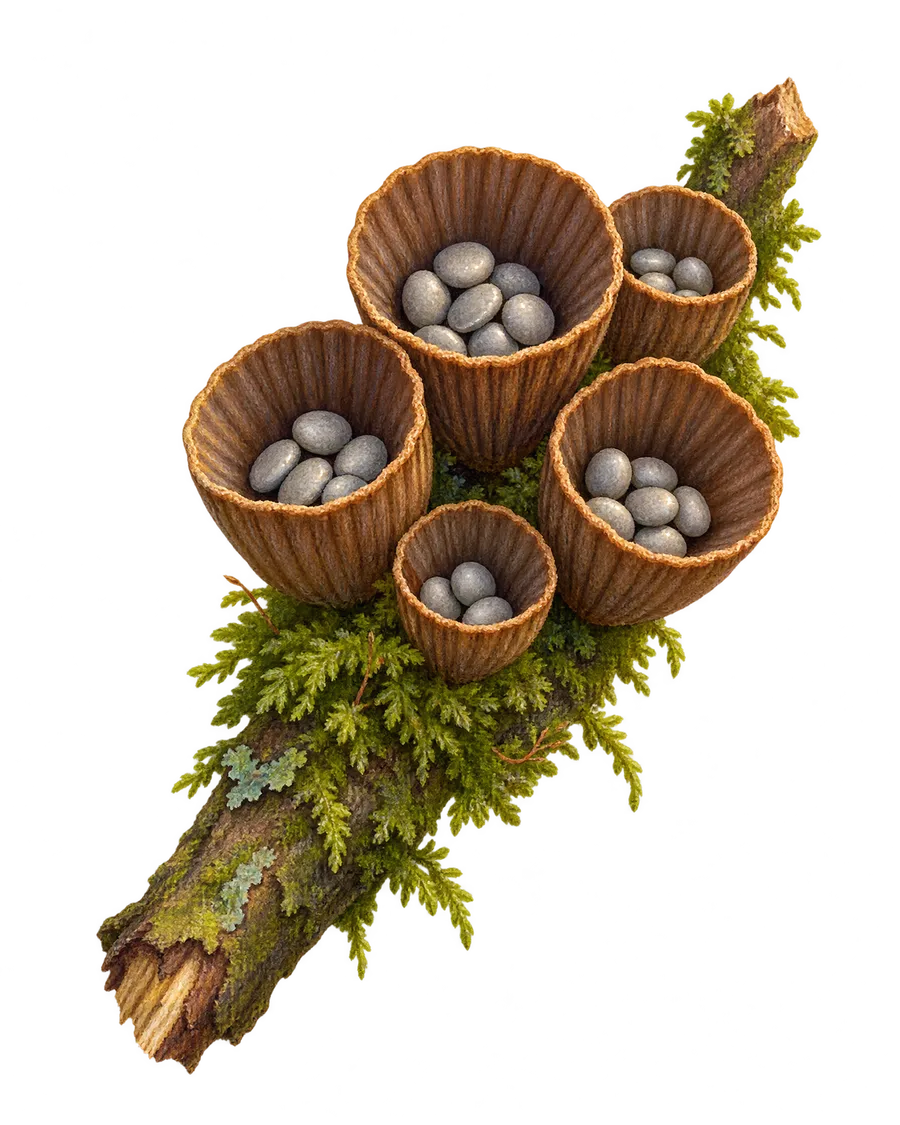
Fluted little cups, smaller than a fingernail, each holding a clutch of silver 'eggs'. When a raindrop lands, the eggs launch into the air.
Fun fact!A falling raindrop can fling the 'eggs' up to a metre away, trailing a sticky cord that snags on plants.
- Where in the world
- Temperate regions worldwide
- Home
- Dead twigs, wood chips and mulch
- When to look
- Summer to autumn
- Size
- Cups 7–15 mm across
Bird’s nest fungi are so small that most people step on them without noticing. Look closely at a pile of wet twigs or garden mulch, though, and you may find a cluster of tiny brown cups, each one holding a few shiny grey “eggs”. They really do look like miniature birds’ nests.
The eggs are spore packets
The eggs are called peridioles. Each one is a hard little capsule packed with spores. The cup is called a splash cup, and it is shaped with a lot of precision. Its sides are just the right angle so that when a raindrop lands inside, the water bounces back out with enough force to launch the peridioles into the air.
A built-in grappling hook
In Cyathus striatus, each peridiole is attached to a coiled, sticky cord. As the egg flies out, the cord unspools behind it. When the sticky end touches a twig or a blade of grass, it catches, and the egg swings around and wraps itself in place. Later, an animal may eat the plant, and the spores pass through and are spread to new places. The inside of each cup is lined with fine grooves, which is where the name striatus comes from.
Where it lives
Bird’s nest fungi are decomposers of small woody debris: dead twigs, fallen bark and especially wood chip mulch, which is why gardeners often discover them.
Not for eating
At under a centimetre across, they are far too tiny and tough to eat. They are, however, one of the most fun fungi to photograph with a macro lens.