No. 05 · Orange & Gold
Chicken of the Woods
Laetiporus sulphureus
“The traffic-cone shelf”
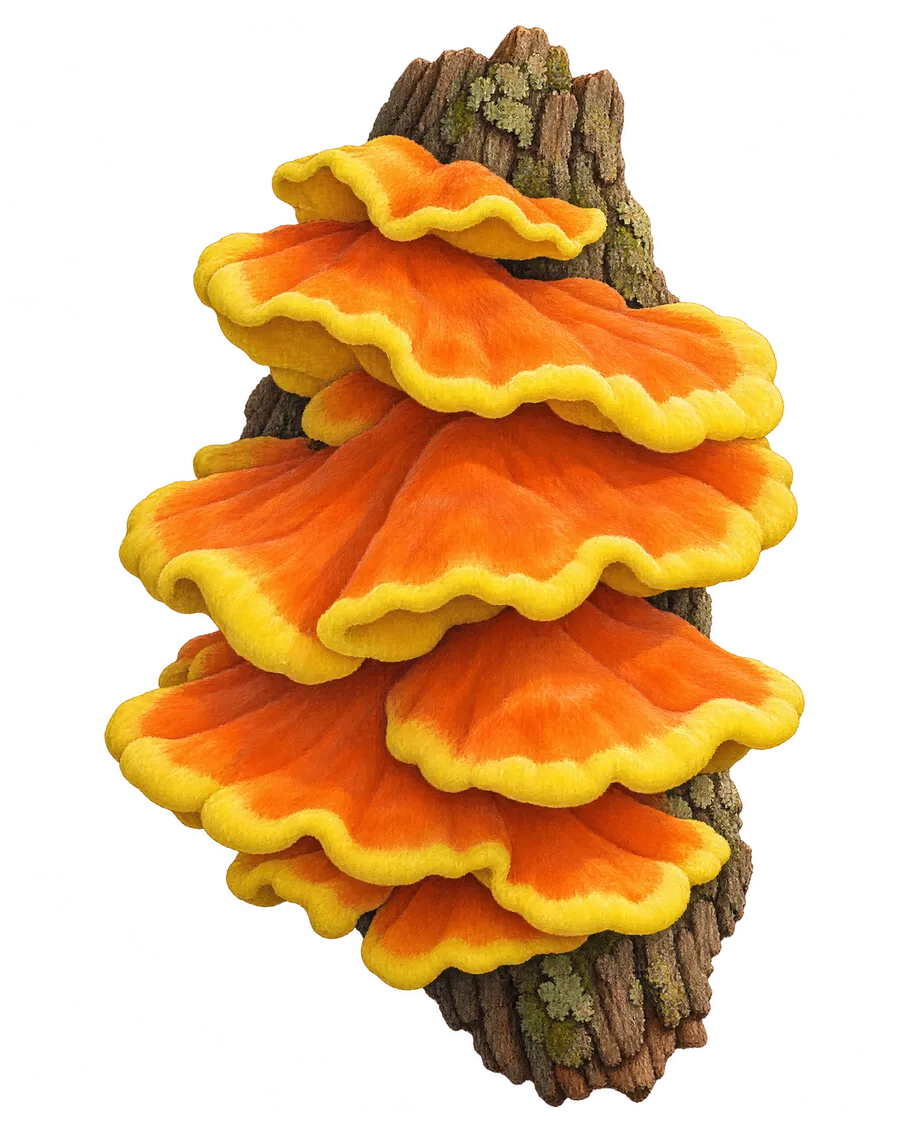
Stacked orange shelves with sulphur-yellow edges, glowing on the side of an oak like a sunset. Impossible to miss, and famous for tasting a lot like chicken.
Fun fact!It has no gills at all. Its spores come out of thousands of tiny pores on the underside of each shelf.
- Where in the world
- Europe and North America
- Home
- Living and dead oak, cherry and other hardwoods
- When to look
- Late spring to autumn
- Size
- Clusters up to 60 cm across
Some mushrooms hide in the leaf litter. Chicken of the woods does the opposite. It grows in bright orange, overlapping shelves on tree trunks, often at eye level, and can be spotted from across a field. Its other common name, sulphur shelf, describes the vivid yellow rim that runs along each bracket.
A polypore
Turn over one of the shelves and you will not find gills. Instead, the underside is covered in tiny pores, and that makes chicken of the woods a polypore. Each pore is the opening of a tube where spores are made. Polypores are some of the most important wood recyclers in the forest.
Where it lives
The fungus grows inside the heartwood of oaks and other broadleaf trees, causing a “brown rot” that slowly breaks the wood into reddish cubes. A tree can live with it for many years, and the shelves often reappear on the same trunk every summer.
In the kitchen
Young, soft shelves are edible and, yes, the texture really is a lot like chicken breast. The tender outer edges are the best part, while the older, woody parts near the tree are tough.
A few sensible rules: always cook it thoroughly, try a small portion the first time because some people’s stomachs do not agree with it, and skip any growing on yew, conifers or eucalyptus. As with every wild mushroom, eat it only after an experienced forager has confirmed the identification.