No. 10 · White & Cream
Cauliflower Mushroom
Sparassis crispa
“A bowl of noodles on the forest floor”
A round, cream-coloured mass of curly ribbons that looks like a sea sponge, a brain or a bowl of egg noodles. Heavy, strange and delicious.
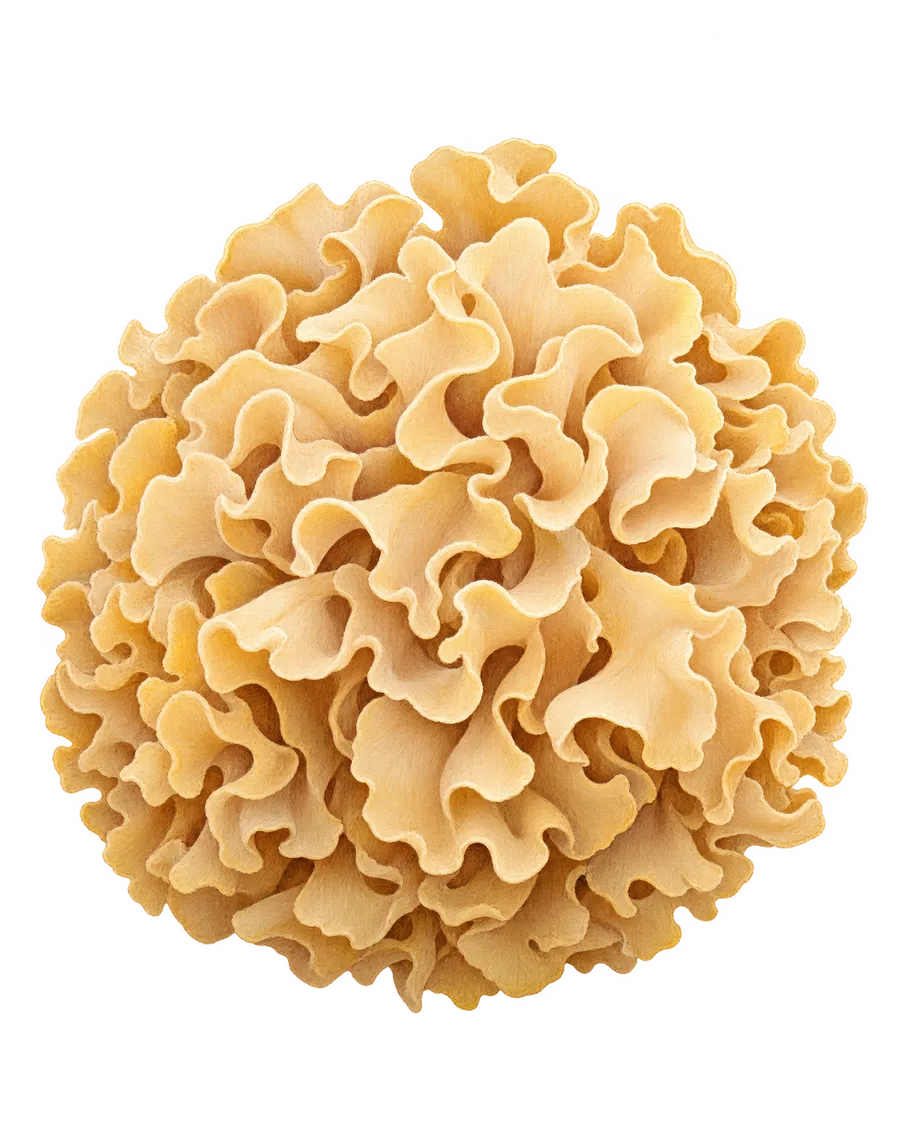
Fun fact!One cluster can weigh several kilograms and keeps growing for weeks.
- Where in the world
- Europe, Asia and North America
- Home
- The base of pines and other conifers
- When to look
- Late summer to autumn
- Size
- 10–50 cm across
The first time people see a cauliflower mushroom, they rarely think “mushroom”. It looks more like a giant sea sponge or a pile of pale, curly pasta sitting at the foot of a pine. Up close, it is made of hundreds of flat, wavy, ribbon-like lobes packed tightly together.
Built for spores
Every one of those ribbons is covered on both sides with spore-producing tissue. Folding a large surface into a compact ball is the same trick used by brains and coral reefs, and it allows a single cauliflower mushroom to release a huge number of spores.
Where it lives
The fungus grows on the roots and lower trunk of pines, spruces and other conifers. It slowly breaks down the heartwood, and it often reappears at the same tree year after year. A cluster can keep growing for weeks and reach several kilograms.
There are a few closely related species around the world, such as Sparassis radicata in western North America and Sparassis spathulata in the east. All of them share the same curly, noodle-like look.
In the kitchen
The cauliflower mushroom is a choice edible with a pleasant, nutty flavour and a firm texture that stays slightly crunchy when cooked. It is perfect in soups and broths. The only challenge is cleaning, because every fold can hide pine needles and soil. Cut it into slices and rinse it well before cooking.