No. 09 · Pink & Red
Lobster Mushroom
Hypomyces lactifluorum
“A mushroom wearing a costume”
Bright red-orange, bumpy and twisted, it looks just like a cooked lobster shell. The twist: it is not one fungus but two.
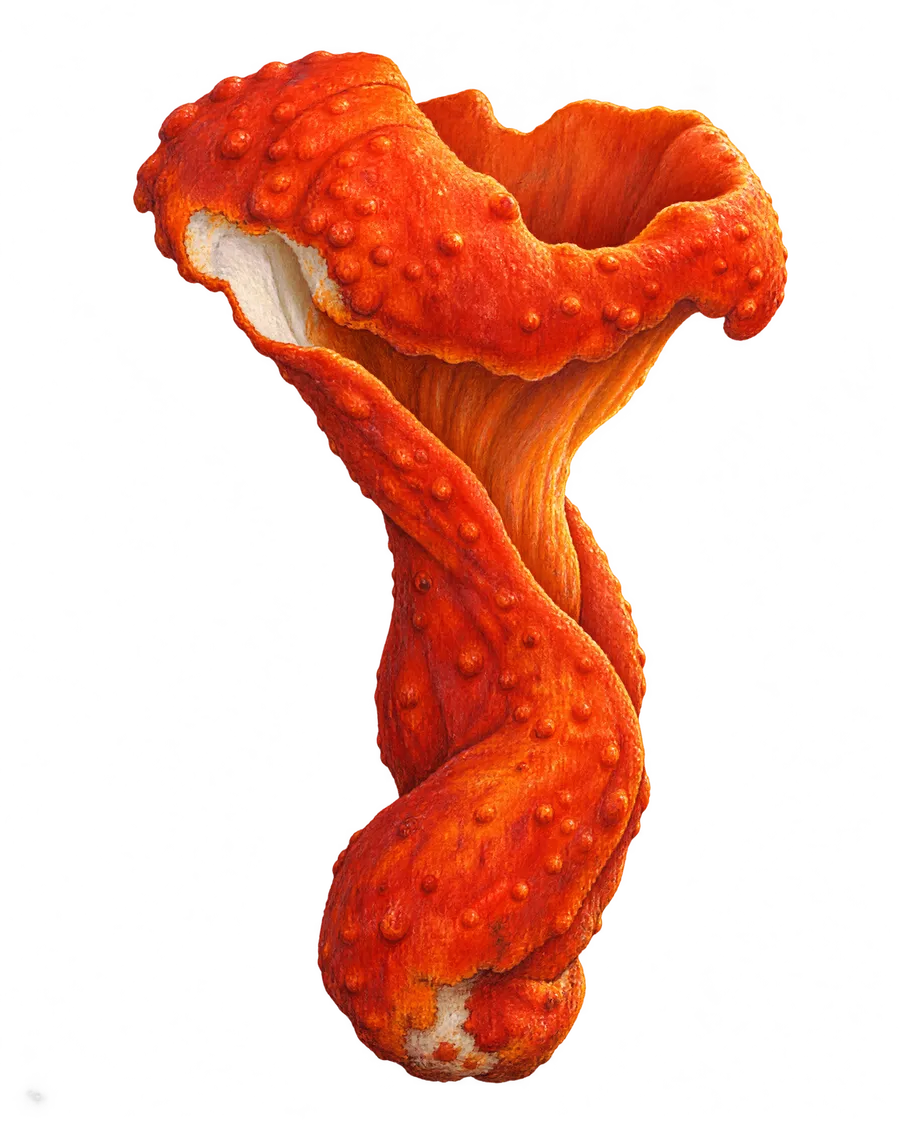
Fun fact!The lobster colour comes from a mould that completely covers another mushroom and reshapes it.
- Where in the world
- North America
- Home
- Mixed forests, near conifers and hardwoods
- When to look
- Summer to autumn
- Size
- 5–20 cm
The lobster mushroom has one of the best stories in the whole fungal kingdom. It is not really a mushroom at all. It is a mushroom wearing a costume.
Two fungi in one
It starts as an ordinary white mushroom, usually a short-stemmed brittlegill (Russula) or a milk cap (Lactarius). Then a fungus called Hypomyces lactifluorum arrives. It coats the whole mushroom in a thin, bright orange-red crust, flattens the gills into blunt ridges and twists the shape. Inside, the flesh turns firm and dense.
By the time it is finished, the original mushroom is unrecognisable. What you hold looks like a piece of boiled lobster tail, and even the surface is covered in tiny bumps.
Where it lives
Lobster mushrooms appear in North American forests from summer into autumn, often half buried in leaf litter or pine needles. Because the host mushrooms are mycorrhizal, you will usually find lobsters near trees.
In the kitchen
This is a choice edible with a firm texture and a mild, slightly seafood-like flavour. It holds up well in long cooking, keeps its colour, and even tints sauces and rice orange. Because the orange crust hides the identity of the host mushroom, buy lobster mushrooms from trusted foragers and specialist shops rather than picking your own.