No. 08 · Blue & Violet
Blue Chanterelle
Polyozellus multiplex
“The midnight bouquet”
Clustered trumpets in dark violet-blue, hidden in the moss of old spruce forests. Rare, beautiful and still keeping scientists busy.
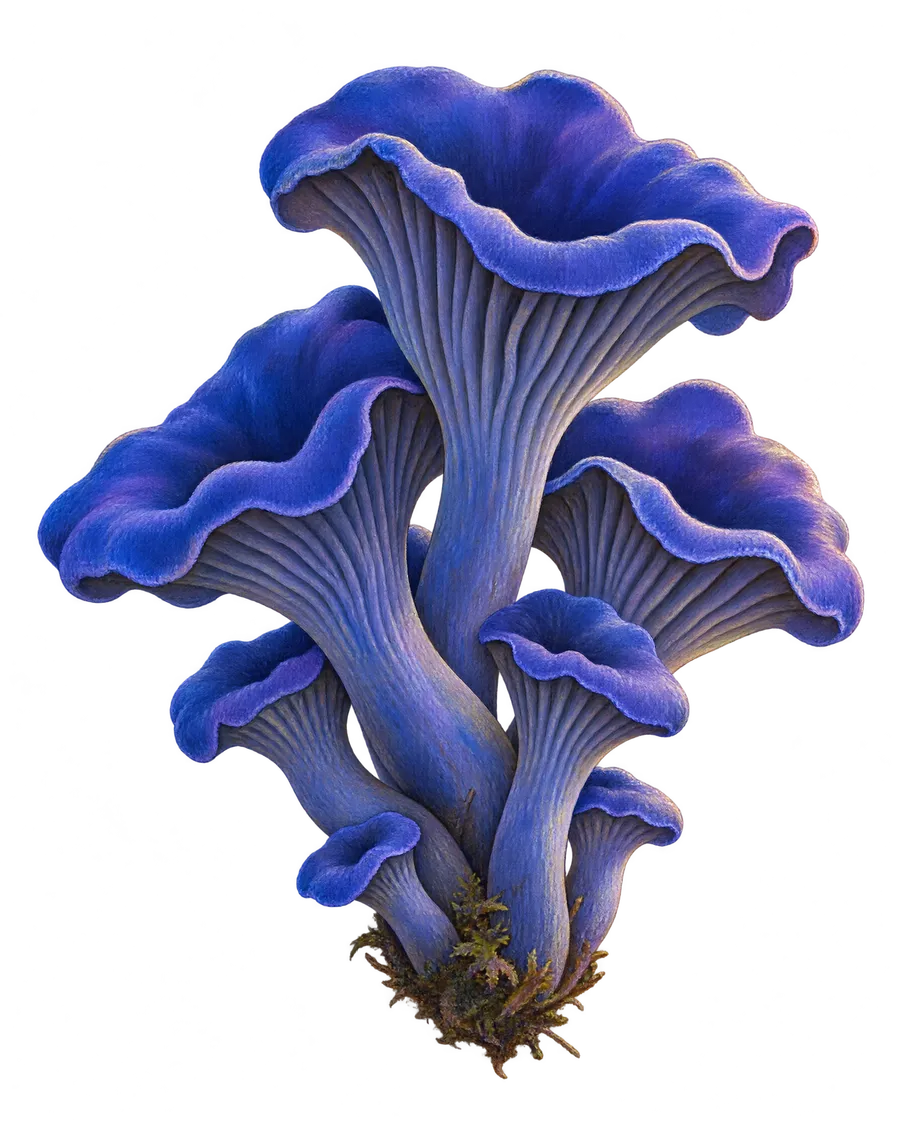
Fun fact!In 2017, DNA studies showed that what everyone called one species is really several closely related ones.
- Where in the world
- Northern North America and East Asia
- Home
- Mossy ground under spruce and fir
- When to look
- Summer to autumn
- Size
- Clusters up to 30 cm across
The blue chanterelle grows in tight clumps of wavy, overlapping trumpets, coloured somewhere between violet, navy and black. In the dim light of a spruce forest, a cluster can look almost like a pile of dark rose petals.
Not a true chanterelle
Despite the name and the shape, it is not a true chanterelle. Its closest relatives are the tooth fungi and earth fans of the order Thelephorales. What it shares with real chanterelles is the underside: instead of sharp gills, it has blunt, branching ridges that run down the stem.
A puzzle for scientists
For a long time, everyone treated all blue chanterelles as one species. In 2017, a group of mycologists compared the DNA of collections from North America and Asia and found that there are actually several distinct species hiding under one name. It is a great example of how much we still have to learn about fungi, even large and colourful ones.
Where it lives
Blue chanterelles are mycorrhizal, partnered with spruce and fir. They prefer old, undisturbed conifer forests with deep moss, and they are uncommon almost everywhere. In parts of North America they are tracked as a rare species.
In the kitchen
They are edible and highly regarded where they are common enough to collect, with a rich, earthy flavour. Given how rare they are, most people choose to admire and photograph them instead.