No. 01 · White & Cream
Lion's Mane
Hericium erinaceus
“The pom-pom of the forest”
A snow-white cascade of soft icicles growing from old hardwood. Lion's mane is one of the most striking tooth fungi on the planet, and one of the best-loved in the kitchen.
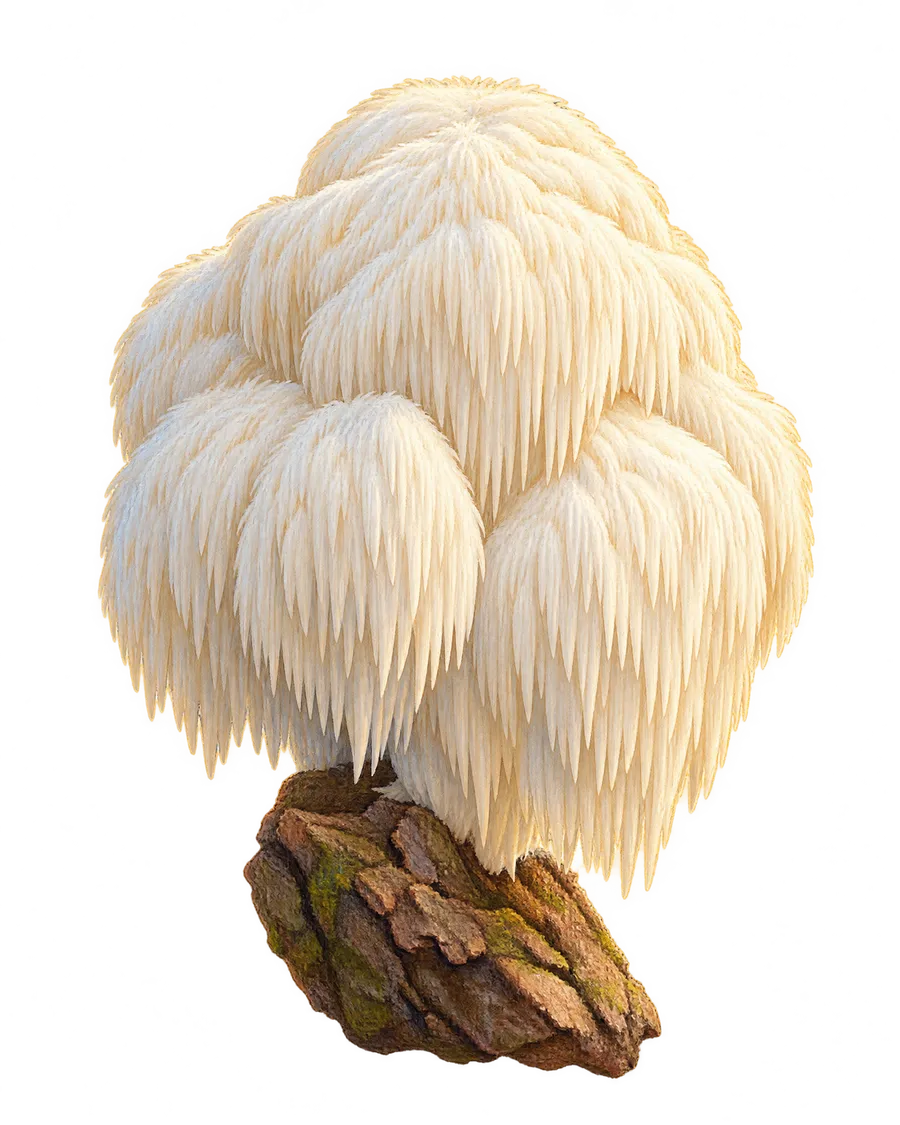
Fun fact!Instead of gills, it releases its spores from hundreds of dangling spines, each up to 5 cm long.
- Where in the world
- North America, Europe and Asia
- Home
- Wounds and dead wood of oak, beech and maple
- When to look
- Late summer to autumn
- Size
- 10–40 cm across
Walk through an old beech wood in autumn and you might spot something that looks like it fell out of a snow globe: a rounded white mass hanging off a tree trunk, covered in long, soft spines that sway when you breathe on them. That is lion’s mane, and once you have seen one you never forget it.
A mushroom without a cap
Lion’s mane belongs to the tooth fungi. There is no cap, no stem and no gills. Instead, the whole fruiting body is a single lump of firm white flesh with spines pointing straight down. Gravity matters here: the spores form on the surface of those spines and simply drop out into the moving air below. Pointing every spine at the ground is the most efficient way to make sure they fall freely.
As the mushroom ages, the white turns to cream and then to a soft yellowish brown, starting at the tips.
Where it lives
The fungus grows inside hardwood trees, usually entering through an old wound such as a broken branch or a lightning scar. It can live inside a tree for years before it fruits. You will mostly find it high on the trunk of mature oak, beech or maple, often in the same spot year after year.
In parts of Europe it is genuinely rare, and in the United Kingdom it is a protected species that should never be picked in the wild. Luckily, it is easy to grow at home on hardwood sawdust blocks, and that is where almost all lion’s mane in shops comes from.
In the kitchen
Cooked lion’s mane is tender and sweet, with a texture often compared to crab or lobster. Tear it into chunks, press out the water in a dry pan, then fry it in butter until golden. It is a favourite with chefs because it soaks up flavour without losing its shape.