No. 02 · White & Cream
Coral Tooth
Hericium coralloides
“A frozen waterfall on a log”
Delicate white branches lined with tiny hanging spines, like frost-covered coral washed up in the woods. The coral tooth is the lace-work cousin of lion's mane.
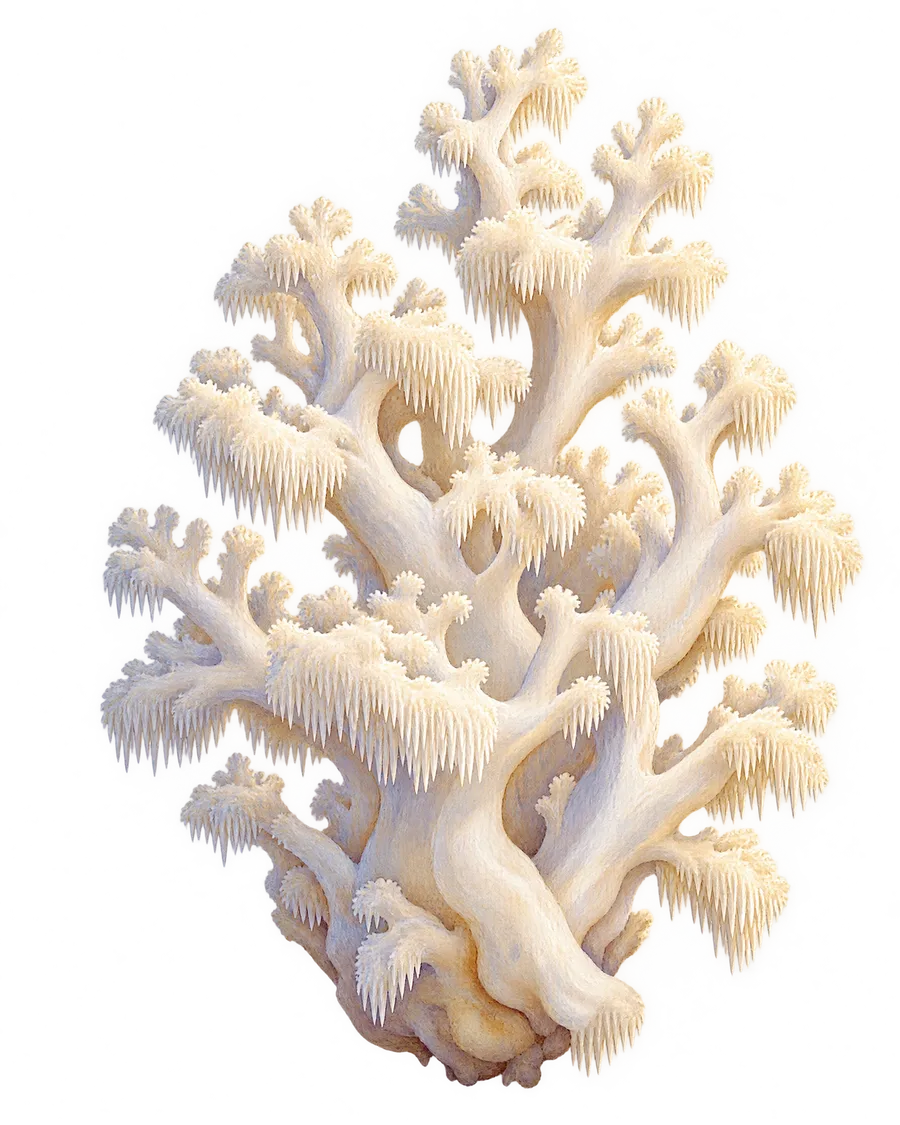
Fun fact!Its spines run along every branch like the teeth of a comb, which is why it is sometimes called the comb tooth.
- Where in the world
- Northern temperate forests worldwide
- Home
- Fallen logs and stumps of beech, birch and other hardwoods
- When to look
- Late summer to autumn
- Size
- 10–30 cm across
If lion’s mane is a pom-pom, the coral tooth is a chandelier. It grows as an intricate tree of white branches, and each branch is lined with rows of short spines that hang down like icicles. Seen in the shade of a forest floor, it seems to glow.
Built like a coral reef
The resemblance to sea coral is not just poetic. Both coral and this fungus solve the same problem: how to fit the largest possible surface into a small space. Every spine is covered with the cells that make spores, so the more branches and spines, the more spores the fungus can release.
The whole structure is surprisingly fragile. Touch it carelessly and branches snap off cleanly, a little like meringue.
Where it lives
The coral tooth is a decomposer. It feeds on dead hardwood, especially fallen beech and birch logs that have been lying for a few years. It is a sign of an old, healthy forest with plenty of dead wood left in place, which is exactly why it has become uncommon in tidy, managed woodlands.
Several countries list it as a species of conservation concern, so the best way to enjoy a wild one is with a camera.
In the kitchen
Young, pure-white specimens are edible and taste mild and slightly sweet, similar to lion’s mane. The branching shape traps forest debris, so cultivated coral tooth is far easier to cook with. It is sold by some specialist growers and looks spectacular simply pan-fried and served whole.